
Building A Sensory Playground
Sensory Integration is the ability to organize, interpret and modulate all of your senses, in order to properly respond to your environment. Sensory Processing Disorder (SPD), sometimes called Sensory Integration Dysfunction is a framework first described by occupational therapist, A. Jean Ayres, PhD, in the 1970s. It refers to the body’s way of handling and processing sensory inputs from the environment. Autism spectrum disorders (ASD) are a group of developmental disabilities that can result in major social, communication, and behavioral challenges. Approximately 1 in 88 children have been identified with an autism spectrum disorder.
Stimulating multisensory environments promote not only physical, cognitive and social development in children, but also the appreciation of both similarities and differences among them. These experiences positively prepare them for the world beyond the playground.
We believe that multisensory play is a priority in our playground designs. We offer a wide variety of play experiences that provide sensory stimulation for children of all abilities. Our playgrounds are accessible and encourage learning, sharing and playing together in a fun, safe, inclusive and engaging environment.
Children may have various responses or reactions to sensory stimuli ranging from under reactions, over reactions or normal reactions. Under reactions may result in children engaging in more of the following behaviors: spinning, jumping, climbing, hitting, biting, fidgeting, over-stuffing mouth when eating, or little or no reaction to sounds. Over reactions may result in children avoiding certain stimuli or activities such as not touching textures (tactile defensiveness), not eating various textures, gravitational insecurity (disliking movement), dislike being
around other children for fear of being brushed-up against, he/she may appear floppy or clumsy, bumping into things, or have uneven balance when standing, walking or running, or he/she may be sensitive to lights or sounds. Children that have over-reactions to sensory stimuli may dislike transitions for fear of this activity, or they become rigid in behaviors that are comfortable to him/her. All children and adults will have various thresholds for which they tolerate sensory stimuli and this is normal. Sensory integration is essential for proper attention and learning, motor planning (coordination), bilateral integration (the ability to use both sides of your body together) and social-emotional health.
Sensory integration includes organizing and modulating the following senses:
tactile: the sensation of touch given to one’s body;
proprioception: the sensation of where one’s
body is in space, through input given to muscle and joints and ligaments (proprioceptive activities include heavy work and/or pressure to joints);
vestibular: the sensation of movement and gravity (vestibular sensation assists with the awareness of body position, postural tone, equilibrium and balance);
auditory: the sensation of sound;
visual: the sensation of sight;
gustatory and olfactory: the sensation of taste and smell.
When developing a playground, devoted to children with sensory processing difficulties, it is important to include for as many sensory components as possible, to maximize a child’s sensory experiences. Because it is difficult to account for a child’s gustatory and olfactory senses on a playground, due to safety and hygiene, playgrounds should account for the motor aspects of sensory integration. Many of the equipment suggestions can
account for more than one sensory system at a time.
Playgrounds, in general are a great social experience for children, and many of the equipment suggestions can be used by more than one child, allowing for many children to further explore and develop their social-emotional well being.
Most people are familiar with the five basic sensory systems of smell, sight, touch, taste and sound. These basic senses or “far senses” respond to external stimuli from the environment. Our bodies also contain sensory systems known as “near senses,” that operate without conscious thought and that we cannot observe.
The “Near Senses”
Playground suggestions:
1) Proprioception: Equipment that makes a child use his/her muscles, or gives joint
compression.
A. Monkey bars or rings (heavy muscle work)
B. Rope stairs: (heavy muscle work throughout body)
C. Tunnels: (crawling provides joint compression in arms, shoulders, legs)
D. Disc swings: or swings that make of child use legs or arms to stay ten(requires heavy muscle work and co-contraction of muscles)
E. Things to push and pull (joint compression)
F. Bouncing pods/ jumping items/trampoline (joint compression and musclework to legs)
G. Ladders (heavy muscle work)
H. Slides- textured materials, e.g. rumble strips, waves, multiple bedways
I. Balance Beams and Pods
2)Vestibular: Equipment that challenges a child’s balance, gravity, or moves;
Movement can be linear and/or rotary; co-contraction of muscles also requires vestibular processing.
A. Platform swing (balance, linear movement, co-contraction of muscles,heavy muscle work for proprioception)
B. Tire swing (rotary and linear movement, co-contraction of muscles)
C. Spinners- The movement experienced in spinning engages the vestibular, proprioceptive, and visual senses.
D. Swings- (linear movement (vestibular) and joint compression (proprioception))
E. Rope ladders that provide movement (movement, balance)
F. Bouncing, Jumping, & Moving bridges (equilibrium, balance)- Bouncing offers vestibular and proprioceptive inputs along with the use of gross motor skills.
G. Spring Riders- Rocking stimulates the vestibular system while also helping to develop muscle tone.
H. Slides (linear movement)- It provides children with sensations of movement and speed without requiring any additional effort. Sliding down the slide offers vestibular input because of movement, while the hard or textured surface of the slide provides proprioceptive input
I. Balance beams (balance)
J. Teeter-totters (balance (vestibular), joint compression (proprioception))
K. Hammocks (movement, tactile)
L. Trampoline (balance (vestibular), joint compression (proprioception))- not recommended for public playgrounds
M. Ramps (equilibrium reactions)
N. Barrels for climbing (balance (vestibular), heavy muscle work for climbing (proprioception))
O. Stairs (balance (vestibular), joint compression (proprioception))
The “Far Senses”
Touch, Sight & Sound: Sensory stimulation occurs when children explore and discover using touch, sight and sound on the playground. This exploration uses a child’s cognitive, tactile, visual, auditory, motor, language and social skills. The tactile system regulates a child’s sense of touch through the receptors of the skin. Touch, visual and auditory senses are closely connected as children play.
Tactile: Various textures
Rugs
Gross
Mats
Texture boards including rough, hard and soft
Sand Play
Water Play
Hard/soft- blocks and foam parts
Loose Parts- Messy Scientist
Visual:
Contrasting colors black/white; red/black (depth-perception)
Twirl-whirly items (depth-perception)
Board with moving parts or tracks (visual-motor and tracking)
Mirrors (eye contact)
Things that go up/down/diagonal (visual tracking)
Mats with hands and feet (spatial orientation and proprioception)
Sound: auditory systems refer to stimuli reaching the central nervous system from the receptors of the ears. The outdoor setting provides an array of sounds if only we take the time to listen, help children focus on and identify the different sounds around, such as children shouting, birds chirping, leaves crunching, dogs barking, and street sounds around them. Children’s auditory experience is enhanced as they hear and listen for new sounds in the outdoors. Children should be encouraged to use their outside voices to sing, shout, and make whatever noises they wish.
Music Components
Chimes
Naturally occurring sounds in nature
Development:
D. Motor Planning
Motor planning allows children to conceive, organize, and carry out unfamiliar sequences of movement in a coordinated manner. Complex circuit play and rope or web climbers requires decision making in a free play environment rather than sequential paths.
Active Play
Web Climbers
Boulders
Play Functional linking
E. Social & Cooperative Play
Opportunities for imaginative play, taking turns, and conversation are vital to a child’s development, as well as assisting them in nurturing their relationships with others.
Toss Up Goals
Multi-person Rocker
Swing-n-Sway Rocker
Matrix Climbers & Complex Climbers

Example of a Sensory Park: Senses Park:
We were tasked with coming up with a multisensory play environment that promoted differences and similarities in kids’ play abilities. We believe that multisensory play is a priority in our playground designs and sought components and play quadrants that were unique to children of varying abilities and sensory seeking needs. Our playgrounds are accessible and encourage learning, sharing and playing together in a fun, safe, inclusive and engaging way.

HIghlights of the Senses Park
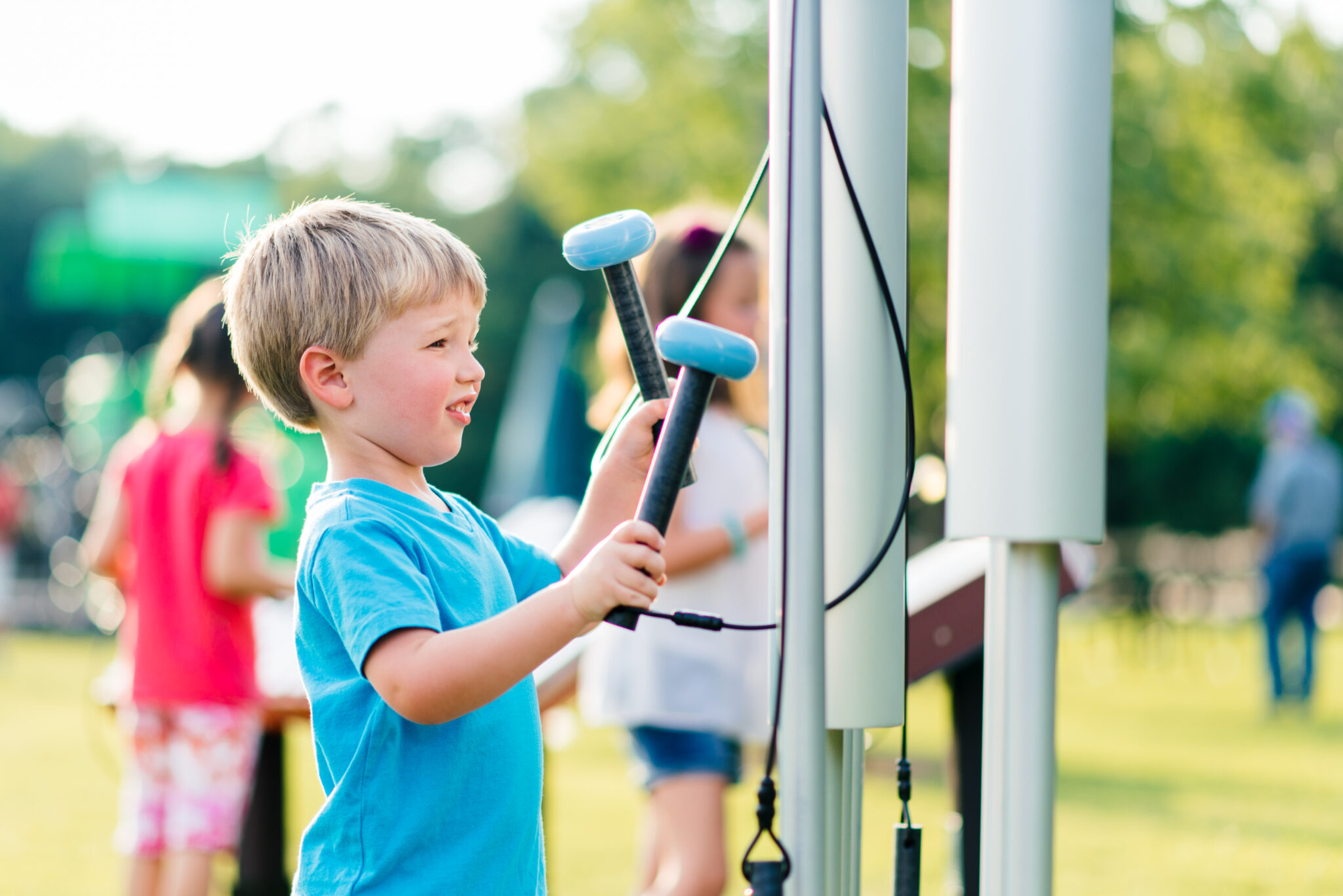
It’s difficult to isolate one aspect of the park that I’d consider a favorite, as every item is purposeful and enriching for the kids’ play experience. The music assembly was a focal point of the park with each of the components being designed to be harmonious. The Contrabass Chimes are a particular favorite, because the vibrations can be felt throughout the body, along with being heard. A child with a hearing deficit can still experience the joy of music radiating through their body.

The Team Swing allows kids to experience vestibular input through swaying and rocking to & fro, while positioning their bodies upright, lying down or on their stomach. Swinging involves both the vestibular and proprioceptive inputs. Balance, eye movement, and body position are a big part of the activity. Swinging, sliding, and spinning are inputs that are difficult to replicate without an action moving against the body, so kids are limited in these experiences unless it’s in a park setting.

The Inclusive Orbit is another focal point on the playground that gives kids that have a mobility device the ability to rotate or spin without leaving their assisting device. The movement experienced in spinning engages the vestibular, proprioceptive, and visual senses and can’t easily be replicated off the playground.

Rubber surfacing- The rubberized surfacing, in addition to being an accessible safety surfacing, is also colorized to differentiate the different play sections on the playground, in addition to be texturized, which adds to the play experience of all children.

Although we’ve isolated some highlights, every component in the playground is meant to elicit a an intentional and unique play experience either individually, with the child’s caregiver, or in a social or cooperative setting.


